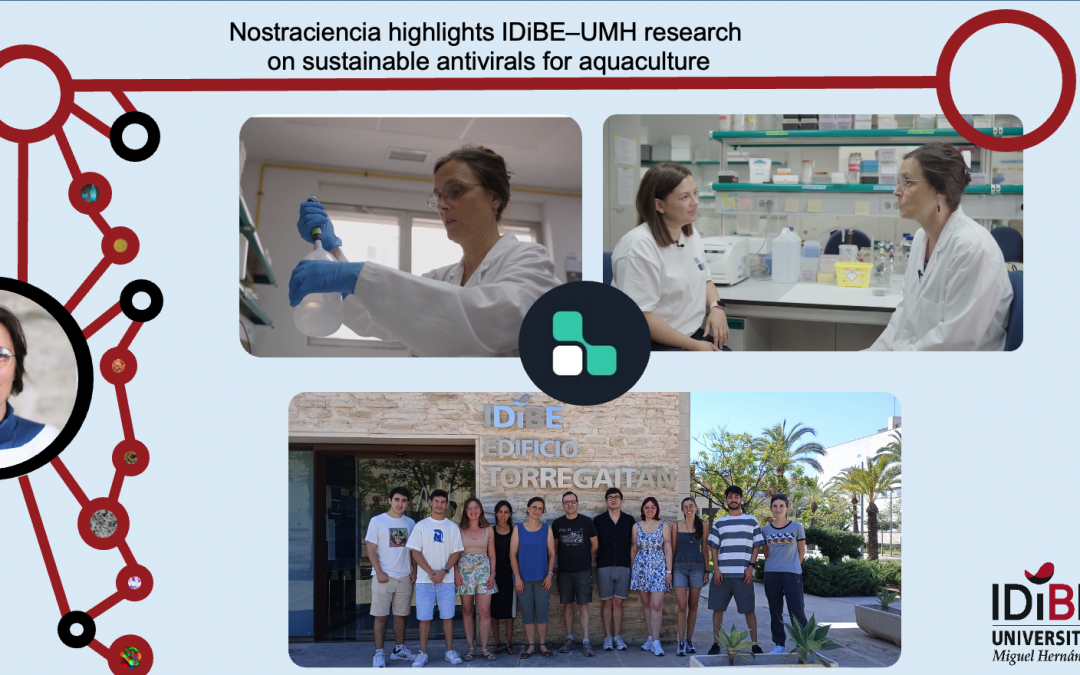
The science communication team Nostraciència has recently interviewed María del Mar Ortega-Villaizán Romo, researcher at the Institute for Research, Development and Innovation in Health Biotechnology of Elche (IDiBE–UMH), to showcase a research line with direct impact on the aquaculture sector.
In the interview, the researcher explains the work carried out by her team on the development of antivirals designed for fish rather than for human use, addressing a critical challenge in aquaculture, where viral infections can devastate entire productions within days.
The research focuses on the identification of plant-derived natural extracts capable of reducing viral infections that cause severe losses in sea bass aquaculture. These extracts are used to formulate feed additives, which are incorporated directly into fish feed, achieving up to a 20% reduction in infection rates, a figure that can be crucial for the survival of aquaculture operations.
As highlighted during the podcast, this approach is environmentally sustainable, involves no negative ecological impact, and is administered through feed without handling the animals, thereby avoiding stress and improving animal welfare. Reducing disease incidence also translates into a direct economic benefit for aquaculture companies.
Beyond the scientific results, the interview also explores María del Mar Ortega-Villaizán Romo’s scientific career, from her early research stages to becoming a university lecturer and principal investigator (PI) of national and European projects. Her testimony underlines the importance of research that goes beyond the laboratory, generating tangible environmental and social impact.
IDiBE–UMH would like to thank Nostraciència for their outstanding science communication work, bringing research closer to society and giving visibility to the work carried out at our institute.
The full podcast is available at:
https://www.youtube.com/watch?v=i2xSgFsmo-I