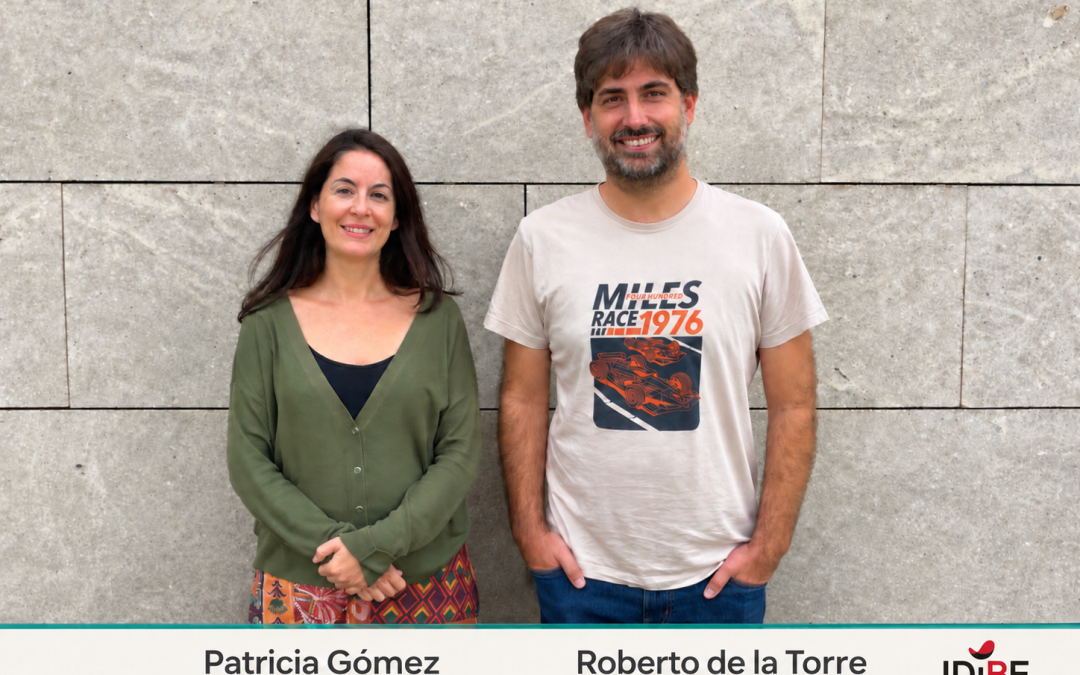
Patricia Gómez Suaga, Ph.D., and Roberto de la Torre Martínez, Ph.D., have chosen IDiBE to develop their scientific careers. Supported by two Ramón y Cajal fellowships and two projects funded under Spain’s National Research Plan, their arrival strengthens the institute’s ability to attract talent and advance new lines of research.
The Institute for Research in Biotechnology and Health at Miguel Hernández University of Elche (IDiBE-UMH) welcomes Patricia Gómez Suaga and Roberto de la Torre Martínez. Having built their careers in international research environments, both are beginning a new chapter at the institute, bringing experience and fresh perspectives for collaboration across research teams.
Their appointments are supported by two Ramón y Cajal fellowships and accompanied by two projects funded through competitive calls under Spain’s National Research Plan: RANPHAGY, led by Patricia, and CLAPTON, led by Roberto. These awards recognise the quality of their proposals and further strengthen the institute’s research activity.
This support is complemented by UMH and IDiBE’s commitment to developing their research programmes, with funding from the Valencian Government’s Endavant programme to help advance their projects.
Patricia Gómez Suaga: understanding the cellular mechanisms behind ALS and frontotemporal dementia
Patricia leads RANPHAGY, a project that aims to better understand the mechanisms underlying a genetic form of amyotrophic lateral sclerosis and frontotemporal dementia (ALS/FTD), diseases for which there is currently no cure.
Her research focuses on how autophagy, the cell’s cleaning and recycling system, influences the production of toxic proteins implicated in these diseases.
This knowledge could help identify new therapeutic targets and contribute to the development of future treatments, including for other rare diseases that share similar genetic alterations.
Roberto de la Torre Martínez: exploring brain circuits and their relationship with chronic pain
Roberto will lead CLAPTON, a project linked to the study of the claustrum, one of the brain’s most extensively connected yet least understood structures.
His research seeks to understand how neurons within this region interact and how their communication with other brain areas contributes to sensory information processing and perception.
Within this framework, he studies how chronic pain can alter the organisation and function of these circuits. Understanding these changes will advance our knowledge of the brain mechanisms that contribute to persistent pain and altered sensory perception.
With these appointments, IDiBE continues to build an environment where researchers can establish their careers, develop new collaborations and tackle challenges in biotechnology and health.
Welcome, Patricia and Roberto!