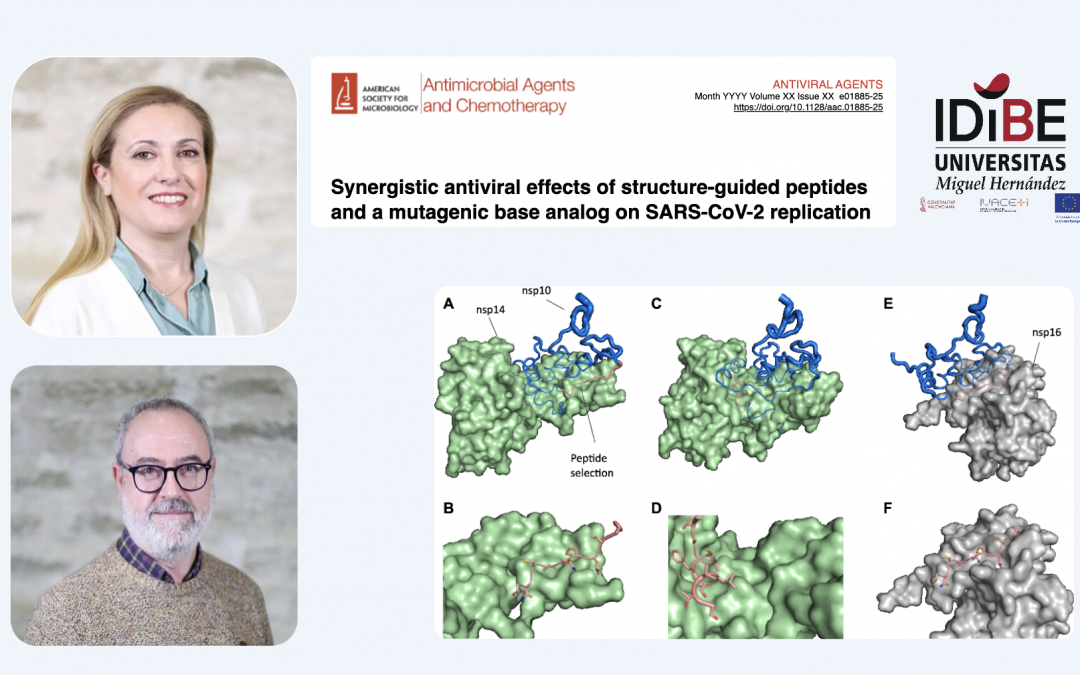
Researchers Ana María Fernández Escamilla and Gregorio Fernández Ballester from the Institute for Research in Biotechnology and Health (IDiBE-UMH) have participated in a study led by the University of Málaga (UMA) that proposes an innovative antiviral strategy against SARS-CoV-2, the virus responsible for COVID-19. The findings, published in the journal Antimicrobial Agents and Chemotherapy, open new avenues for the development of more effective treatments against emerging coronaviruses and future resistant variants.
The study presents a therapeutic approach based on the combination of two complementary mechanisms. On the one hand, structure-guided peptides were designed using computational modeling techniques to target viral proteins that are essential for both viral replication and immune evasion. On the other hand, a mutagenic nucleoside analog was used to increase the accumulation of errors in the viral genome during replication. The combined action of these two strategies produced a strong synergistic effect, dramatically reducing viral infectivity and promoting viral genetic collapse.
Results obtained in cell culture models demonstrated that this combination not only reduced viral load but also profoundly altered the genetic diversity of the virus, limiting its ability to adapt and survive. Furthermore, because the targeted viral proteins are highly conserved among different coronaviruses, this strategy could provide the foundation for the development of broad-spectrum antiviral therapies.
The study is the result of a multidisciplinary collaboration led by the University of Málaga, involving researchers from several Spanish institutions, including IDiBE at Miguel Hernández University of Elche, IBIMA Plataforma BIONAND, Virgen de la Victoria University Hospital, the Severo Ochoa Molecular Biology Center (CSIC-UAM), the Autonomous University of Madrid, and the Jiménez Díaz Foundation.
Ana María Fernández Escamilla’s contribution highlights IDiBE’s commitment to excellence in biomedical research and to the development of innovative therapeutic strategies against infectious diseases with major public health impact. This work represents a significant step toward more robust antiviral treatments that are less prone to the emergence of resistance.
🔗 More information: https://www.youtube.com/watch?v=72AD-3X-twE&t=6s
📖 Reference
Ortega Del Campo S, Fernández Ballester GJ, Blanes Mira C, Guirado Osorio V, Díaz Martínez L, de Ávila AI, Soria ME, Martínez-González B, Villena González FJ, Gómez-Maldonado J, Viciana Ramos MI, Clavijo Frutos E, Santos González JL, Bastolla U, Perales C, Domingo E, Viguera E, Fernández Escamilla AM, Grande Pérez A. (2026). Synergistic antiviral effects of structure-guided peptides and a mutagenic base analog on SARS-CoV-2 replication. Antimicrobial Agents and Chemotherapy, e01885-25. https://doi.org/10.1128/aac.01885-25